Is It Love or Is It Trauma? How to Tell Connection from a Trauma Bond
In this article
You felt it from the very first moment. An overwhelming connection, an intensity you had never experienced with anyone, the certainty that this person was special, different, "the one." Everything in you said yes. And months later you're in a relationship that destabilizes you, that makes you suffer, that you recognize as harmful but can't leave. You wonder how something that felt so much like love ended up like this. The uncomfortable answer is that what you mistook for love may have been something else: the activation of a wound. Learning to distinguish love from trauma is one of the skills that saves the most suffering.
The trap is that both feel intense, and our culture taught us to read intensity as proof of true love. But intensity doesn't distinguish between connection and hooking. Sometimes the body lights up because it found someone to build with; sometimes it lights up because it recognized an old, dangerous pattern. And they feel similar.
Intensity proves nothing
Let's start by dismantling the central myth. That feeling of "I've known them my whole life," that immediate, fierce chemistry, that swept-away certainty, is not necessarily a sign of deep compatibility. Often it's a sign of familiarity: your system recognized, in the other person, a known dynamic —even if it was painful— and activated forcefully.
As we explained in why you always choose the same person, the brain is attracted to the familiar, and for many people the familiar in love includes instability, intermittency, or distance. When someone fits that template, the system recognizes it and lights up, and that ignition is mistaken for love at first sight. It's not the love of your life calling: it's your history repeating itself.
The difference is in what it does to your nervous system
Since intensity can't tell the difference, you have to look at something else: what the relationship does to your internal state. And there a clear difference appears.
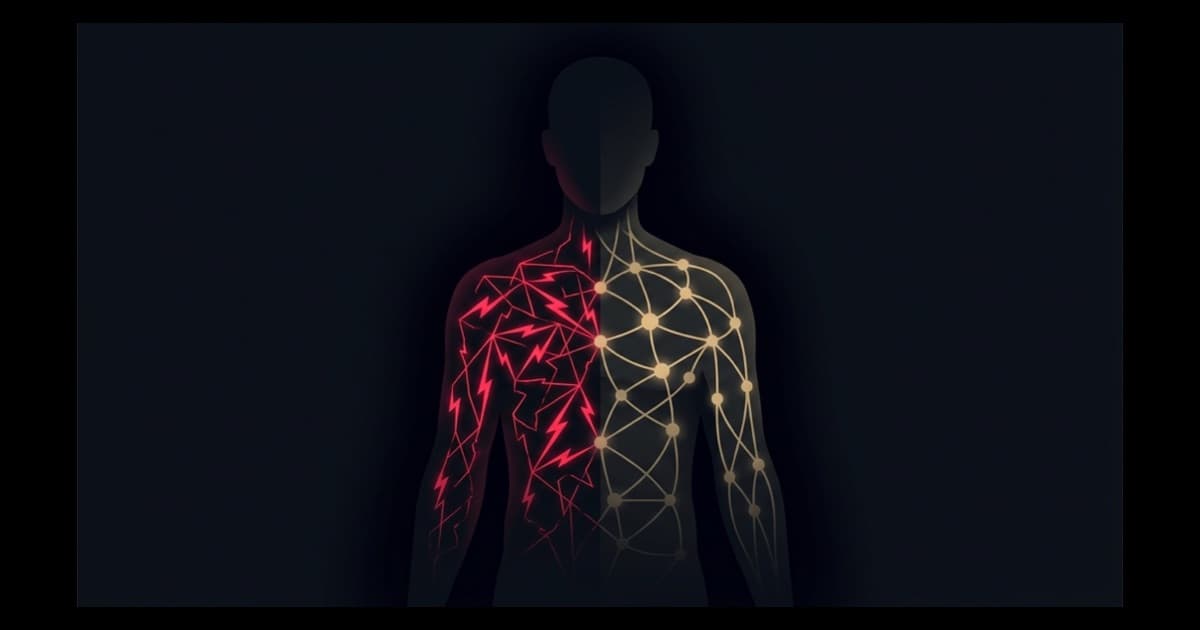
Love, even passionate love, tends to regulate you. It gives you a base of security, it calms you, it expands you: you can be intense at first, but the bond, at its core, settles you. This is what we call co-regulation: the other person's presence stabilizes your nervous system. This shows up in the body: your heart rate normalizes with the other person, your sleep improves, your cortisol levels (stress hormone) drop when you're with them. Not because the relationship is perfect, but because the nervous system registers safety.
Traumatic hooking, on the other hand, dysregulates you. You live on a roller coaster: euphoria and anguish, closeness and panic, extremely high moments followed by crashes. Your nervous system is chronically activated —on alert, on standby, intermittent— and that activation is mistaken for passion. It's the mark of the traumatic bond: the relationship doesn't give you a base, it keeps you on edge. Neurochemically, what happens is that dopamine and adrenaline levels rise and fall in abrupt peaks. The body becomes familiar with that roller coaster and starts to depend on it. It's like a neurochemical addiction: the peak is what you need to feel alive, but the crash gets lower each time.
The useful question, then, isn't "how strongly do I feel it?" but "does this relationship stabilize me or destabilize me?" Not "how many butterflies?" but "am I more at peace or more on alert?" True peace isn't the absence of emotion; it's the ability to be excited without being constantly on defense. In a secure bond, you can have a conflict and then reconcile calmly. In a traumatic one, every conflict is an existential threat that leaves you battered for days.
Other signs to tell them apart
Calm. In a real connection, calm is well tolerated and even enjoyed. In hooking, calm feels bland, boring, suspicious —the system needs drama to feel alive, because it reads tranquility as the absence of love. In neurochemical terms, it's because the system is habituated to adrenaline peaks. The absence of those peaks is interpreted as emotional death, when in reality it's health.
Peace with yourself. Healthy love generally leaves you liking yourself more. Traumatic hooking tends to leave you doubting yourself, anxious, diminished, worried about losing the other person. You notice a clear difference: after spending time with the person, do you feel better or worse about yourself? Does your self-esteem grow or erode? Love builds; trauma consumes.
The price of intensity. Ask yourself what the relationship costs you: your peace of mind, your self-esteem, your other relationships, your sleep. If intensity is paid for with your underlying well-being, it's probably not love sustaining it. This is crucial: true love makes you stronger, not more fragile.
Repetition. If this story looks suspiciously like others you've already lived —the same endings, the same pains, the same type of person— it's a strong clue that a pattern is playing out, not a new encounter. Your system recognizes the terrain because it already bled there. Familiarity feels like destiny, but it's just history repeating itself.
What you say about the relationship. Notice how you talk about this person with close friends. Do you make a lot of exceptions? Do you need to convince others that they're a good person? Do you constantly justify their behavior? In a real bond, the people who love you understand it without you having to explain so much. In hooking, you spend a lot of time arguing why "it's not what it looks like."
Why does the body lie about love?
There's something important to understand about the bodily compass: the nervous system has no way to distinguish between excitement from danger and excitement from connection. Both feel like intensity, like "something important happening." That's why someone who grew up under constant threat may have learned to confuse hypervigilance with passion. The body feels the activation and the mind says "this is love," when what's actually happening is that the system is on high alert, scanning the other person the way you scan a threat: looking for signs of rejection, rechecking inconsistencies, prepared to act fast if things change.
This explains why many people feel "more" with a traumatic person than with a secure one. Not because there's more love, but because there's more adrenaline. The wounded body doesn't recognize safety as safety; it feels it as boredom or indifference. And threat, paradoxically, feels like belonging. It's a profound misunderstanding of the body about what keeps it alive versus what keeps it wounded. Understanding this is the first step to stop blindly trusting that compass.
Why is it so hard to see it from the inside?
Distinguishing is hard while you're inside, because hooking feels like love and because the system, fully activated, defends the relationship with all its arguments. Additionally, for someone whose attachment template includes chaos, the calm of a healthy relationship can feel "cold" or "lacking spark," which leads to dismissing exactly what would do them good. Relearning to read safety as something desirable, and not as boredom, is part of building secure attachment in adulthood.
What role does fear of abandonment play in confusing trauma with love?
There's a deep connection between fear of abandonment and the confusion between trauma and love. For someone whose attachment system was constantly activated in childhood —by an inconsistent caregiver, by early losses, by messages that love was something to be earned— the fear of abandonment lives in the body permanently. That fear generates constant vigilance: it looks for signs of rejection, interprets every distance as a threat, and sees the intensity of a traumatic relationship as a guarantee that this time they won't be abandoned.
The paradox is that traumatic hooking, precisely because of its instability, constantly awakens that fear. If the relationship were secure and predictable, the system could rest. But if it's chaotic, intermittent, sometimes close and sometimes distant, the fear is reactivated again and again —and each reactivation is mistaken for passion. The brain says "what I feel must be love, because it's so strong, because it hurts, because I can't live without it." But what's actually happening is that the abandonment the system feared is being recreated continuously, and that fear is what keeps you hooked.
Breaking this pattern requires doing something counterintuitive: choosing calm when fear screams at you to flee, to seek confirmation, to secure the other person. Every time you tolerate safety without needing drama, you're teaching your system that abandonment doesn't automatically arrive when there's peace. That tranquility in a relationship isn't a sign of lack of love, but of you finally being safe. This is slow, because the system distrusts calm, but it's the only thing that rewrites the recording of fear.
The question that changes everything
In Homo Amans, the confusion between love and trauma appears as one of the deepest roots of romantic suffering: mistaking the activation of a wound for the meeting of a lifetime. Intensity is not the measure of love. What is, rather, is what the relationship does to your nervous system over time: whether it gives you a base or keeps you on edge, whether it expands you or shrinks you, whether it leaves you at peace or on alert. Learning to ask yourself that question —and to trust the body's answer more than the hooking's— is what finally allows you to distinguish the person who loves you from the one who only activates what already hurt you.